Who Does the Art Work for the Cleveland Zoo
 | |
 Cleveland Metroparks Zoo Entrance | |
| Date opened | 1882[1] |
|---|---|
| Location | Cleveland, Ohio, United States |
| Coordinates | 41°26′49″Northward 81°42′43″Westward / 41.447°Northward 81.712°Due west / 41.447; -81.712 Coordinates: 41°26′49″Northward 81°42′43″W / 41.447°Due north 81.712°West / 41.447; -81.712 |
| Land area | 183 acres (74 ha) |
| No. of animals | 3000 |
| No. of species | 600 + |
| Annual visitors | 1,227,593 (2007)[ii] |
| Memberships | AZA[3] |
| Website | www |
The Cleveland Metroparks Zoo aka Cleveland Zoological Park is a 183-acre (74 ha) zoo in Cleveland, Ohio. The Zoo is divided into several areas: Australian Adventure; African Savanna; Northern Wilderness Expedition, The Primate, True cat & Aquatics Building, Waterfowl Lake, The RainForest, and the newly added Asian Highlands. Cleveland Metroparks Zoo has one of the largest collections of primates in Northward America,[2] The Zoo is a part of the Cleveland Metroparks system.
The Cleveland Metroparks Zoo was founded in 1882. It is one of the most popular year-circular attractions in Northeast Ohio by attendance with a ii% increase from the previous year to ane.2 million visitors in 2007, compared to the Cleveland Indians who were the most popular allure in Northeast Ohio in 2007 with a total attendance of over 2.2 meg.
History [edit]
The Zoo, originally named the Cleveland Zoological Park, get-go opened in 1882 at Wade Park where the Cleveland Museum of Art at present stands. During its early on years, the Zoo only held animals of local origin. In 1907, the city of Cleveland moved the Zoo to its current location in Quondam Brooklyn, and the Zoo caused its kickoff elephant.[4] Beginning in 1910, the Zoo constructed Monkey Island, body of water lion pools, and a moated bear exhibit. Past 1940, the Zoo was home to three elephants and its first (permanent) elephant resident since 1924.[4] That same year, the Cleveland Museum of Natural History assumed control of the Zoo.
Between 1955 and the transfer of management to the Cleveland Metroparks in 1975, the Zoo experienced rapid expansion despite setbacks due to flooding: the Zoo's reptile drove and several other buildings were lost when Big Creek overflowed in January 1959.[1] Although the Zoo had recovered by 1962, it would non have another permanent reptile collection until the opening of the RainForest 30 years later. Ostrich races proved popular in 1965 and 1966 and a large public swimming puddle sabbatum on the grounds from 1930 until the 1960s.
Structure began on the Primate & Cat Building in 1975 (the Aquatics section would exist added in 1985), afterward followed by the RainForest in 1992, Wolf Wilderness in 1997, Australian Gamble in 2000, and the Sarah Allison Steffee Eye for Zoological Medicine in 2004.[1] Newer exhibits include the Asian highlands and Tiger Passage opened in 2017 and 2018, and The Rhino Reserve was completed in 2020.
The Zoo's official website states that it currently has 3,000 animal residents representing more than than 600 different species.[v]
Building/allure history [edit]
The following is a timeline of when selected buildings and exhibits were created:

Wade Hall, built in 1884, moved from its original location in University Circle in 1970.
- 1882: Cleveland Zoological Park opens at Wade Park (at present University Circle)
- 1884: Wade Hall is built
- 1907: Cleveland'south City Quango moves the Zoo to its current location; the Cleveland Museum of Art is built
- 1934: Monkey Isle is completed
- 1956: Pachyderm Building is built
- 1970: Wade Hall is moved to its current location on the shore of Waterfowl Lake
- 1975: Construction began on the Primate & Cat Building
- 1985: Aquatics portion of the Primate & Cat Edifice is added
- 1992: The RainForest is completed
- 1997: Wolf Wilderness is completed
- 2000: Australian Adventure is completed
- 2004: Sarah Allison Steffee Middle for Zoological Medicine opens
- 2008: Pachyderm edifice closes to make room for African elephant crossing
- 2011: African Elephant Crossing opens[half dozen]
- 2015: Ben Gogolick Giraffe Encounter opens[seven]
- 2016: Rosebrough Tiger Passage opens
- 2018: Asian Highlands opens
- 2019: Monkey island is demolished to make fashion for rhinoceros reserve
- 2020: Rhino reserve opens
- 2021: Eagle Zip Hazard opens [8]
Leadership Emeritus, Cleveland Metroparks Zoo (CMZ) [edit]
Distinguished Emeritus Staff (CMZ) [edit]
National Zoo Association Awarded Cleveland Metroparks Zoo Staff with Honorary Memberships [edit]
Retired Cleveland Metroparks Zoo administrators and career zoo and aquarium professionals Daniel Moreno and Donald Kuenzer were recognized as Honorary Membership Winners by the Association of Zoos and Aquariums. Recipients of Honorary Membership are recognized as the most esteemed and distinguished zoo professionals in North America.
According to the AZA website, Honorary Membership is conferred by the AZA Board of Directors upon those AZA members who accept made "pregnant contributions to the zoological profession during their careers."[9]
Moreno and Kuenzer are included in a list of other notable Due north American zoo and aquarium professionals. Other recipients include William Grand. Conway, Hon. PhD (Director General/President Emeritus, Bronx Zoo-based Wild fauna Conservation Social club), Lester Fisher, DVM (Veterinarian/Manager Emeritus, Lincoln Park Zoo), Murray Fowler, DVM (Veterinary/Professor, University of California), Jack Hanna, Hon. PhD (Manager Emeritus, Columbus Zoo and Aquarium), Charles H. Hoessle, Hon. PhD (Director Emeritus, Saint Louis Zoo), Marvin Jones (Registrar Emeritus, San Diego Zoo), Peter Karsten (Manager Emeritus, Calgary Zoo), Edward Maruska, (Director Emeritus, Cincinnati Zoo and Botanical Garden), Dennis Meritt, Jr., Ph.D. (Professor/Assistant Director Emeritus, Depaul Academy/Lincoln Park Zoo), George B. Rabb, PhD (President/Director Emeritus, Brookfield Zoo), Alan H. Shoemaker, MS (Curator Emeritus, Riverbanks Zoo), Kurt Benirschke, Dr. (Lath of Trustees, San Diego Zoo), Gary Grand. Clarke (Director Emeritus, Topeka Zoo), Roger Conant, Hon ScD (Curator Emeritus, Toledo Zoo) and Ted A. Beattie (President/Director Emeritus, Shedd Aquarium).[10]
Daniel Moreno [edit]
Dan Moreno joined the Cleveland Metroparks Zoo subsequently serving three decades at the helm of the Cleveland Aquarium every bit both its director and curator under the auspices of the Cleveland Museum of Natural History. The Cleveland Aquarium's animal drove was "absorbed" past the Cleveland Metroparks Zoo in 1986 after structural elements of the aquarium building forced its closing.
Until his retirement in 1997, Moreno managed the aquatic beast collections at the Cleveland Zoo under General Curator Don Kuenzer. He supervised animal husbandry programs for the Rainforest and Aquatics exhibits. Moreno was a charter fellow member of the Association of Zoos and Aquariums (originally the American Association of Zoological Parks and Aquariums) and served on its Board of Directors from 1971 to 1976.[eleven]
In 2012, the Greater Cleveland Aquarium opened to the public as the only free standing aquarium in the state of Ohio.
Donald Kuenzer [edit]
Don Kuenzer retired afterwards a 40-year career serving in multiple capacities, including senior curator, full general curator and acting director. In 1961, Kuenzer began his career at the Cleveland Zoo'due south Petting Farm as an attendant beast intendance technician. Later serving as an beast keeper, he was promoted to Assistant General Curator in 1975 past zoo director Dr. Leonard Goss.[12] [xiii]
Kuenzer was credited with designing The Rainforest, a state-of-the art indoor naturalistic living exhibit dedicated to the display of tropical and subtropical species from multiple continents.[xiv] He served on the Board of Regents for the Association of Zoos and Aquariums.
Past directors/directors emeritus, Cleveland Metroparks Zoo [edit]
Leonard Goss, DVM, PhD (seventh managing director) [edit]
Dr. Goss (1913-1999) was a veterinary pathologist and retired from the Cleveland Zoo (later renamed the Cleveland Metroparks Zoo) as its director in 1979. Prior to bold the managing director position in Cleveland, he was the fourth chief veterinarian at the New York Zoological Lodge's Bronx Zoo as well as banana manager of the Bronx Zoo. Dr. Goss was President of the AZA and twice Vice-President.
At the Bronx Zoo, which is the headquarters for the Wild fauna Conservation Club (WCS), Goss conducted clinical, epidemiological and pathological research in collaboration with eminent field zoologist George Schaller. Schaller was the Managing director of the Bronx Zoo'south Animal Research and Conservation Center, which is now referred to every bit the Wildlife Conservation Social club's Global Conservation Program.[xv]
The Cleveland Zoo has since made efforts to replicate this type of collaborative inquiry relationship every bit demonstrated by Drs. Goss and Schaller in the 1970s and more recently past Atlanta, Chicago (Lincoln Park & Brookfield), National, San Diego, and Saint Louis zoos.
In the mid and late 1990s General Curator Hugh Quinn hired Patricia McDaniels equally the first of three successive curators for the Cleveland Metroparks Zoo'southward Science and Conservation section. The unit of measurement now has a veterinary epidemiologist on staff. Sharon Deem, DVM, PhD Dipl. ACZM (at present with the Saint Louis Zoo), was the commencement formally trained epidemiologist on staff and was both a researcher and experienced clinician from the National Zoo.[sixteen] [17]
When Dr. Goss, a graduate of the Cornell University and The Ohio State Academy veterinary colleges returned to Ohio to assume the role as director of the Cleveland Zoo, he connected to conduct research in zoological medicine and related animal science disciplines.[18] Goss was a president of the Board of Directors of the Association of Zoos and Aquariums (previously the "American Zoo and Aquarium Association", and originally the "American Association of Zoological Parks and Aquariums").
Michael Vitantonio (8th managing director) [edit]
Michael "Mike" Vitantonio was hired as the eighth managing director of the Cleveland Zoo in its 130 plus year history.
Steve H. Taylor, BS (9th director) [edit]
Inspired by the Goggle box show Zoorama, zoo director emeritus Steve H. Taylor began his zoo career in 1972 every bit an animal keeper at the Los Angeles Zoo. Co-ordinate to his website, he is now a "Zoo Consultant and Entertaining Speaker".[19] [17]
Taylor continues to advise zoos, including the Akron Zoo every bit both a professional consultant and fellow member of its lath of trustees. He also served on the Board of Directors of the Association of Zoos and Aquariums. Prior to moving to Ohio, Taylor was the director of the 5-hectare Sacramento Zoo.
Taylor resigned as director of the 5-hectare zoo in Sacramento to accept the directorship of the 70-hectare zoo in Cleveland. In his memoirs, published in a newsletter, Taylor described the Cleveland Metroparks Zoo to be poorly managed and "undistinguished" when he assumed the position equally its 9th director. He credits himself for improving the conditions for both animals and staff over his 24-year career in Cleveland.[17]
Exhibits [edit]

Map of the current Cleveland Metroparks Zoo
The Cleveland Metroparks Zoo is divided into several bio-thematic areas that house animals from unlike regions of the earth. Each surface area is themed for the particular region of the globe they represent, although the older areas (such as the Primate, Cat & Aquatics Building) are less thematic than those that were constructed more recently. Upon inbound, visitors arrive in the Welcome Plaza which features administrative buildings, an amphitheater, food court, and the Zoo's largest souvenir store. Numerous smaller concession/souvenir stands are located throughout the park.
Aside from walking, Zoo patrons may opt to ride the 2 "ZooTram" lines which shuttle visitors between the Welcome Plaza (most African Elephant Crossing) and the Primate, Cat & Aquatics Building; and between the Welcome Plaza (nearly the food court) and the Northern Trek.
The RainForest [edit]
The RainForest, opened in 1992, is one of the nearly popular exhibits at the Cleveland Metroparks Zoo. It is contained in a large, two-story building with over 2 acres (8,100 m2) of floor space, making it one of the largest indoor tropical environments in the world. The RainForest boasts more than than 10,000 plants and over 600 animals from the tropical regions of Asia, Africa, and the Americas.[20] The opening of the RainForest also introduced the Metroparks Zoo'southward first permanent reptile collection since the flooding in 1959.[ane]
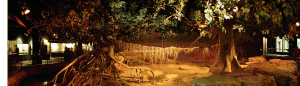
Tropical Pelting Tempest exhibit located in the RainForest
The RainForest is housed in a big glass and granite building, but outside the main entrance to the Zoo. The construction is divided into an outer band—featuring an assortment of tropical plants, exhibits containing pocket-size mammals, a cafeteria, and a souvenir shop—and an inner area that contains the principal animal exhibits. Animal habitats are located on both floors of the RainForest. The exhibits contained on the ground flooring are collectively known as the "Lower Woods", and those on the second flooring are known every bit the "Upper Forest".

RainForest building exterior
Upon entering the RainForest, visitors are immediately greeted by a cascading, 25-pes (7.6 g) waterfall and a big tropical garden that soars upwards two stories. The wall behind the waterfall resembles Ancient Mayan ruins. Within the wall are a series of exhibits featuring small, New World mammals such as Pied tamarins, Geoffroy's tamarins, Goeldi's marmosets, White fronted marmosets and endangered gilt lion tamarins.[21] The outer band of the RainForest is besides home to a broad variety of tropical plants including lancepods, balsam apples, tropical almonds, lipstick trees, numerous varieties of orchid, a kapok tree, and the rare titan arum (corpse blossom). The fundamental exhibit, chosen "Tropical Rain Storm", is a lifelike recreation of a rainforest isle where simulated tropical rainfall occurs periodically. The island is inhabited by several Indian porcupines.
The major beast of the Rainforest is the Bornean orangutan, of which the zoo has four: male Tiram and females Kera Wak, Kayla, and Merah.[22] Merah is the most recent Orangutan baby at the zoo, born in 2014 to Tiram and Kera Wak.[23]
Animals independent in the RainForest include: Red-rumped agoutis, Straw colored fruit bats, Rodrigues flying foxes, behemothic anteaters, capybaras, ruby-red ibis, prehensile-tailed porcupines, White faced whistling ducks, two-toed sloths, Asian water monitors, Ocelots, Overcast leopards, Ringed teals, green and black poison pointer frogs, macaws, Mouse deer, a reticulated python, dark-green vine snakes, Roseate spoonbills, batagur turtles, Asian small-clawed otters, François' langurs, extremely rare fishing cats, and several gharials equally well equally invertebrates, amphibians, turtles, and a Dwarf crocodile.
African Savanna [edit]
The African Savanna area is located well-nigh the park archway. Visitors can observe African lions, flamingos, giraffes, zebras, bontebok, a variety of African birds, black rhinos, Slender horned gazelles, and colobus monkeys. the African elephant crossing contains elephants and meerkats.[24] On February 7, 2018, a baby rhino, named Lulu, was born to parents Forrest and Kibbibi.[25] On August 20 of the same year, another babe rhino, named Nia, was born to parents Forrest and Inge.[26]

Sarah Allison Steffee Eye for Zoological Medicine
The Sarah Allison Steffee Center for Zoological Medicine
Equally part of Cleveland Metroparks Zoo's focus on conservation, the Zoo constructed the Steffee Center for Zoological Medicine in September 2004. The center hosts medical, laboratory and surgical suites, in addition to a ward and quarantine expanse. Its veterinary hospital is equipped with the get-go CT scanner for use in a zoo hospital.[27] Located in a nearby pavilion is the Reinberger Learning Lab, where Zoo patrons can learn about veterinarian intendance at every stage of an animal'south life. The Learning Lab offers interactive, hands-on educational displays every bit well as views into surgical suites where visitors may detect handling procedures in progress.
African Savanna and Ben Gogolick Giraffe Encounter
Consisting of several large yards, the African Savanna features a variety of mammals and birds. The exhibit houses animals such as Masai giraffes, Grant's zebras, bonteboks, ostriches, grey crowned cranes, Slender horned gazzels equally well as several species of African storks and geese. In 2015, the Ben Gogolick Giraffe Encounter was completed, and visitors are now able to purchase leaves to feed the giraffes.[7]

African Elephant Crossing
In 2011, the Zoo opened its new elephant showroom, African Elephant Crossing. At a total toll of $25 meg, the state of the art habitat quadrupled the elephants' living space, allowing the zoo to increase its number of African elephants from three, to a herd of eight to 10. The exhibit features two big ranges—the Savanna and the Mopani—spread out over several acres. The ranges include deep ponds so that the elephants tin swim, as well as expanded sleeping quarters. Areas of the ranges are also heated to maximize the elephants' habitat during the wintertime months. Periodically throughout the day, the elephants are shepherded across the pathway betwixt the ranges, allowing visitors an up-close view of the animals. In addition to expanding the number of African elephants, the African Elephant Crossing exhibit introduced meerkats, naked mole rats, an African rock python and several species of birds.
Australian Adventure [edit]

Wallaby found in the Australian Run a risk
The Australian Risk surface area is an eight-acre (iii.two ha) exhibit designed to resemble the Australian outback. Information technology is home to wallaroos, kangaroos, Emu and wallabies that roam freely throughout Wallaby Walkabout. Zoo patrons can learn how sheep are sheared at Kookaburra Station, and feel up-close encounters with Southdown sheep, goats, Alpacas and other farm animals in the adjoining Contact Chiliad. The Australian Chance is also home to a 55-foot (17 m) Yagga Tree, which contains creature exhibits and a serpent slide for younger visitors.[28] Due to Northeast Ohio's inclement winters, Australian Run a risk is weather condition dependent in the colder months.
Gum Leaf Hideout
Located in Koala Junction, Gum Leafage Hideout is home to the zoo's collection of bettongs, koalas, Matschie's tree-kangaroos, and short-beaked echidnas. The exhibit also features interactive displays that teach visitors about the devastating furnishings of deforestation on Australian ecosystems.
Reinberger Homestead
Modeled after a traditional 19th-century sheep station, the Reinberger Homestead offers Zoo visitors a expect into Australian dwelling house life. The expanse contains animatronics of a koala and Kookaburra, who speak about the culture.[ citation needed ]
Wallaby Walkabout and Boomerang Railway
Designed to replicate the Australian outback, Wallaby Walkabout features winding paths that visitors share with kangaroos, wallabies, and wallaroos during the months of April through Oct.[29] The landscape includes vegetation intended to be consumed by the animals. Families can besides take a train ride through the showroom. In July 2007, the Zoo savage under scrutiny from PETA after a one-yr-sometime kangaroo was struck and killed by the exhibit'south "Boomerang Railway" railroad train. In response, the Zoo quickly dismissed the employee who was operating the train, and installed a argue along the tracks to forbid future injuries from happening.[30]
Yagga Tree
The bogus, 55 pes tall Baobab known as the Yagga Tree is the star of Australian Adventure. Information technology contains exhibits for a prehensile-tailed skink, a cane toad, and a carbohydrate glider, likewise as another animatronic, this time a crocodile named Wooly Nib.[28]
Wilderness Trek [edit]
The Wilderness Expedition area is home to common cold climate animals such equally Siberian tigers, grizzly bears, Tufted deer, Reindeer, the endangered Persian onager, and Red crowned cranes which remain active outdoors year-round. The California bounding main lion/harbor seal exhibits feature large pools for visitors to discover the animals at play. The Metroparks Zoo also contains one of the largest collections of bear species in North America, including grizzly bears, Andean bears, Malayan lord's day bears, North American black bears, and sloth bears.[31] On January xiv, 2019, a female person sloth acquit named Shive gave birth to a female cub named Shala. Shala was the first sloth behave cub born at the zoo in 30 years
Wolf Wilderness
Wolf Wilderness gives visitors a comprehensive look into the surround and wildlife of a northern temperate forest. Wolf Social club, which anchors the exhibit, serves as an education and viewing centre for gray wolves, beavers, and a variety of wetland species. Wolf Wilderness is one of the principal Due north American habitats at the Cleveland Metroparks Zoo. The showroom consists of the Wolf Order, a large woodland enclosure for the wolves, a 65,000-gallon swimming, and panoramic viewing rooms.

Visitors admission the exhibit through the Wolf Lodge, a 3,000-foursquare-foot (280 grand2) building that is modeled subsequently a 19th-century fur trading post.[32] Upon entering, visitors arrive in the welcome middle, which offers data on the indigenous animals of North America's deciduous forests and wetlands; this room leads into the two main showroom areas.
The get-go exhibit room is dedicated to the 6 Mexican gray wolves contained in a vast, wooded surface area straight behind the Wolf Lodge. Zoo patrons are able to discover the wolves through a large viewing room with flooring-to-ceiling windows, which look out into the habitat. Surveillance cameras inside the enclosure are linked to monitors in the viewing room, allowing visitors to see the wolves fifty-fifty when they are out of direct view.
The viewing room leads into the second showroom area—the wetlands and wolf display room. Hither, visitors tin can observe both the wolves and several other North American animals through floor-to-ceiling windows, similar to the viewing room. Although visitors can too view the wolves from this room, the principal exhibits are the Canadian beaver habitat, the 65,000-U.s.a.-gallon (250,000 l; 54,000 imp gal) freshwater pond, and the Zoo's collection of baldheaded eagles.[33] The Canadian beaver habitat features an artificial beaver dam with cantankerous-sectional windows that grant visitors a gamble to view the beavers' nest within. The freshwater pond is adjacent to the viewing windows, thereby creating an aquarium effect that allows visitors to run into what a wetland pond looks similar beneath the h2o'southward surface. The pond contains numerous fish indigenous to the North American wetlands.
Rosebrough Tiger Passage
Opened June 3, 2016, this showroom features "4 dissever, interconnected habitat areas for the [zoo's] Amur tigers to roam", and includes "two overhead elevated pathways".[34] [35] [36]
Asian Highlands
Asian Highlands opened June 12, 2018. This exhibit features expanded habitats for snow leopards, Amur leopards, and red pandas, and too includes takins.[37] [38] on April 22, 2018, three snowfall leopard cubs were born.
Primate, Cat & Aquatics [edit]

Opened originally as the Primate & Cat Building in 1975, the Primate, Cat & Aquatics Edifice houses one of the largest collections of primate species in North America,[39] including western lowland gorillas, New Earth monkeys, aye-ayes, and several species of lemur. Still, the building does non house the Zoo'due south entire primate population; numerous primate species tin can also be institute in the RainForest. In 1985, the Cleveland Aquarium permanently closed and donated its collection of exotic fishes and invertebrates to the Metroparks Zoo.[1] A department of the Primate & Cat building was renovated to accommodate the new Aquatics section, which currently features 35 table salt- and freshwater exhibits include piranhas, a giant Pacific octopus, electrical eels, fish and hundreds of living coral.[2]
The Primate, Cat & Aquatics Building has also featured outdoor exhibits such equally the outdoor department of the gorilla exhibit and fossas. The zoo's slowest resident, the Aldabra behemothic tortoise, tin exist found in the enclosure straight across from its fastest resident, the chetah. Several of the tortoises are over ane-hundred years onetime.
Waterfowl Lake [edit]
The marshy shallows of Waterfowl Lake are home to Chilean flamingos, Black swan, and Canvasback ducks , trumpeter swans. During the summertime months, Müller's gibbons and lemurs populate the lake'southward islands, and use ropes suspended above the water to navigate between them. Visitors tin observe predatory birds such as Andean condors and Steller'southward bounding main eagles in-flight within towering, outdoor flight cages on the lake's eastern shore.[twoscore] The nearby Public Greenhouse contains hundreds of tropical plant species in addition to a seasonal butterfly exhibit.[twoscore] Waterfowl Lake is as well the site of Wade Hall, 1 of the oldest zoo buildings in North America.[41] Today, the hall serves as a Victorian water ice cream parlor for Pierre's Ice Cream Visitor.
Monkey island [edit]
Notability and Recognition [edit]
Recognition [edit]
Cleveland Metroparks Zoo Recognized Among Five "All-time" Zoos in Ohio [edit]
The Cleveland Metroparks Zoo is i of five city zoos in Ohio. The 'Buckeye State' has been referred to as a "Zoo State", as but California rivals Ohio in the sheer number of options zoogoers have for visiting reputable zoos.
A 2014 "Top Ten" ranking of the nation's zoos past USA Today (based on data provided past the Association of Zoos and Aquariums) recognized the Cleveland Metroparks Zoo for being nominated for the United states Today award. 3 other Ohio zoos were nominated and won awards for the 'All-time The states Zoo' contest: the Columbus Zoo and Aquarium, the Cincinnati Zoo and Botanical Garden and the Toledo Zoo.[42]
Notable Animals [edit]
Timmy (Gorilla) [edit]
Arguably the most famous animal resident in the Cleveland Metropark Zoo's history, Timmy attained greater fame as a very prolific sire at the Bronx Zoo. Although, he was known every bit the "dud stud" at the Cleveland zoo, he proved to be quite virile after he arrived at the Bronx Zoo on loan. Timmy was managed indoors in human care for 25 years before being sent on convenance loan to the Wildlife Conservation Society's primary campus and headquarters at the Bronx Zoo.
The motion was highly controversial. The consideration of separating Timmy from his companion Kate, was met with much protest by brute rights activists and was the subject of a federal court case. Cleveland Metroparks Zoo Director Emeritus Steve H. Taylor cites the lawsuit surrounding the convenance loan as one of the most significant in the history of moderns zoos.[17]
All the same, Timmy went on to sire more than than 13 offspring in New York, many of whom were conceived in the Bronx Zoo's state-of-the-fine art Congo Gorilla Forest showroom, which opened after his arrival in New York City.[43] [44]
Okpara [edit]
Sired by Timmy and born to Pattycake (gorilla) at the Bronx Zoo, Okpara returned to Cleveland before moving on to another facility.
Blackie [edit]
In 2014, the Cleveland Metroparks Zoo's Nile Hippopotamus "Blackie", was euthanized at approximately 60 years of age.[45] Blackie may have been the longest-lived male Nile hippopotamus ever recorded in human care in North America. As far as hippos go, he had a gentle demeanor and weighed approximately 3700 lbs.[45]
Aldabra Tortoises [edit]
The Zoo cares for three tortoises, including a pair of animals both exceeding 100 years of historic period.[45]
Services and special events [edit]
Teaching and outreach [edit]
Cleveland Metroparks Zoo hosts day and overnight camps for children ages 5 to 14 during the summer months. The Summertime Day Camp programme teaches children about conservation and encourages understanding of the natural world. Overnight opportunities include stays in the Australian Adventure's Reinberger Homestead; stays in the Wolf Guild, where guests can use the same tracking technology utilized by field scientists; and the African-themed "Rising Waters Safari Army camp".[46] Campers at Rise Waters stay in the zoo'south African Savanna for an accurate safari experience complete with creature encounters. Each overnight program combines elements of Australian, Native American and African culture with an overarching theme of conservation.[46]
Other educational opportunities include the Zoo's "Keeper for a Mean solar day" program, which is open to centre school, high school, and college students who are interested in a career working with animals. Similar to a chore shadowing program, program participants spend a day working with animal professionals in the Zoo's Conservation Education Division.[47] Participants are tasked with preparing meals, cleaning enclosures, conducting preparation exercises, and providing animals with enrichment items to stimulate them both mentally and physically.
The Cleveland Metroparks Zoo is a role of Miami University's graduate-level Advanced Enquiry Program (AIP). The program offers a Master of Arts in Biology or Master of Arts in Teaching through online coursework and confront-to-face experiential learning experiences at the zoo.
Conservation support [edit]
The zoo too offers numerous grant opportunities which fund research and conservation projects around the world.[48] In 2011, the zoo and Zoological Society awarded grants to more than 90 field conservation projects and programs in 39 countries.[49] Some of these projects include elephant conservation in southern Africa, studying gorilla ecology and beliefs in primal Africa, and anti-poaching initiatives for Asiatic freshwater turtles.[49] Over the by ten years, the Cleveland Metroparks Zoo has supported more 600 conservation projects in virtually 100 countries.[l] Current initiatives include "Quarters for Conservation" and spreading awareness of the burgeoning Palm Oil Crisis in Malaysia and Indonesia.
Events [edit]
Boo at the Zoo
Cleveland Metroparks Zoo'south annual fall issue, "Boo at the Zoo", takes place in Oct. Visitors can observe the various cold conditions animals that still roam outside, and are encouraged to wear costumes to the park.[51] The Boo at the Zoo outcome is a safe Halloween option that offers animal shows, live performances, and other fall-related activities.
DINOSAURS!
During the summer months, the Zoo features prehistoric animals forth the wooded path around Waterfowl Lake. Younger visitors have the opportunity to dig for "fossils" and learn almost the field of paleontology. The 2007 and 2010 "DINOSAURS!" exhibits showcased dinosaurs from around the world: Tyrannosaurus male monarch, Stegosaurus, Triceratops, Pteranodon, Omeisaurus, Dilophosaurus, Baryonyx, Iguanodon, Styracosaurus, Apatosaurus, Kentrosaurus, Brachiosaurus, Suchomimus and more than.[52] The 2013 "DINOSAURS!" exhibit featured 20 animatronic dinosaurs, including Quetzalcoatlus and Troodon.
Rentals [edit]
Stillwater Identify
In Leap 2015, the Cleveland Metroparks Zoo opened a new reception upshot center, Stillwater Place.[53] Offering scenic views of nearby Waterfowl Lake and a capacity of up to 300 guests, Stillwater Identify is open yr-circular and caters to many occasions, such equally weddings, birthdays, reunions and more than.
Incidents [edit]
In 2015, Mitchelle Schwab was charged after allegedly dropping her 2-yr-old son into a cheetah exhibit. His parents were finally able to retrieve him from the exhibit and was taken to MetroHealth Medical Center.[54]
Notes [edit]
- ^ a b c d e "Zoo History: Attendance Climbs Again at Cleveland Metroparks Zoo". clemetzoo.com. Cleveland Metroparks Zoo. 8 January 2008. Retrieved seven May 2011.
- ^ a b c "Attendance Climbs Once again at Cleveland Metroparks Zoo". clemetzoo.com. Cleveland Metroparks Zoo. 8 January 2008. Archived from the original on 29 Jan 2008. Retrieved 7 May 2011.
- ^ "Currently Accredited Zoos and Aquariums". aza.org. AZA. Retrieved 7 May 2011.
- ^ a b "All elephants at Cleveland Metroparks Zoo in United States". elephant.se. Koehl D, Elephant Encyclopedia. Retrieved 26 July 2011.
- ^ "Archived copy". Archived from the original on 2013-07-01. Retrieved 2013-07-07 .
{{cite spider web}}: CS1 maint: archived copy as title (link) - ^ African Elephant Crossing, "Archived copy". Archived from the original on 2009-02-xx. Retrieved 2008-08-fourteen .
{{cite web}}: CS1 maint: archived copy as championship (link) - ^ a b "Cleveland Metroparks Zoo Opens new Giraffe Encounter". Cleveland Metroparks.
- ^ "Fly like an Eagle with Cleveland Zoo's new zipline". Retrieved 2021-07-28 .
- ^ "Honorary Membership Honor". Aza.org . Retrieved v Baronial 2018.
- ^ "Honorary Membership Winners". Aza.org . Retrieved v August 2018.
- ^ "Pulsate and CROAKER : A Highly Irregular Journal for the Public Aquarist" (PDF). Drumandcroaker.org . Retrieved 5 August 2018.
- ^ "Old Brooklyn News" (PDF). Oldbrooklynhistory.org. Jan 2007. Retrieved 5 August 2018.
- ^ "Animal Business firm". Oldbrooklynhistory.org . Retrieved five August 2018.
- ^ "Is It Live or Is It Larson?". Si.com . Retrieved 5 Baronial 2018.
- ^ "Celebrating Over a Century of Zoological Health". Wcsarchivesblog.org. nineteen Oct 2016. Retrieved 5 Baronial 2018.
- ^ "Archived re-create". Archived from the original on 2017-02-19. Retrieved 2017-02-xviii .
{{cite web}}: CS1 maint: archived copy as title (link) - ^ a b c d "Waza news 4 2013". Issuu.com . Retrieved 5 August 2018.
- ^ "The New Yorker Digital Edition : Sep 27, 1952". Athenaeum.newyorker.com . Retrieved five Baronial 2018.
- ^ "Steve Taylor Zoo". Stevetaylorzoo.com . Retrieved v August 2018.
- ^ "Archived copy". Archived from the original on 2013-09-21. Retrieved 2013-07-07 .
{{cite web}}: CS1 maint: archived copy as title (link) - ^ The RainForest, "Archived copy". Archived from the original on 2013-08-07. Retrieved 2013-07-08 .
{{cite web}}: CS1 maint: archived re-create every bit title (link) - ^ Ewinger, James (2017-x-05). "Cleveland Metroparks Zoo celebrates young orangutan'south 3rd birthday (photos, video)". cleveland.com . Retrieved 2019-04-24 .
- ^ "Babe Orangutan Built-in at Cleveland Metroparks Zoo".
- ^ "Archived copy". world wide web.clemetzoo.com. Archived from the original on 14 July 2013. Retrieved 27 January 2022.
{{cite web}}: CS1 maint: archived copy as title (link) - ^ "Cleveland Metroparks Zoo rhino, Lulu, celebrates 1st altogether". fox8.com. 2019-02-07. Retrieved 2019-04-24 .
- ^ "Cleveland Metroparks Zoo Babies".
- ^ "Zoo". Clemetzoo.com . Retrieved 5 August 2018.
- ^ a b Australian Adventure, "Archived copy". Archived from the original on 2008-x-09. Retrieved 2008-08-12 .
{{cite web}}: CS1 maint: archived copy equally championship (link) - ^ "Archived copy". Archived from the original on 2009-02-20. Retrieved 2008-08-12 .
{{cite spider web}}: CS1 maint: archived copy as title (link) - ^ "PETA wants zoo fined for Kangaroo death". Blog.cleveland.com . Retrieved five August 2018.
- ^ "Archived re-create". Archived from the original on 2011-06-30. Retrieved 2013-07-15 .
{{cite web}}: CS1 maint: archived copy equally championship (link) - ^ "Archived copy". Archived from the original on 2007-10-05. Retrieved 2008-02-02 .
{{cite spider web}}: CS1 maint: archived re-create as title (link) - ^ Wolf Wilderness, "Archived copy". Archived from the original on 2009-02-20. Retrieved 2008-02-02 .
{{cite spider web}}: CS1 maint: archived re-create every bit title (link) - ^ Cleveland Zoological Society. "Rosebrough Tiger Passage". Archived from the original on 12 June 2016. Retrieved iii June 2016.
- ^ Julien, Sanaa (24 September 2015). "Cleveland Metroparks Zoo Announces New Tiger Exhibit for 2016" (Press release). Cleveland Metroparks Zoo. Archived from the original on 13 June 2016. Retrieved 3 June 2016.
- ^ Ischay, Lynn (3 June 2016). "Rosebrough Tiger Passage Opens at Zoo". The Evidently Dealer . Retrieved iv June 2016.
- ^ "Cleveland Metroparks Zoo Celebrates Opening of Asian Highlands & Announces Asian Lantern Festival Coming in July" (Press release). Cleveland Metroparks Zoo. 12 June 2018. Retrieved 13 June 2018.
- ^ DeMarco, Laura (7 June 2018). "Cleveland Metroparks Zoo's New Asian Highlands Exhibit to Open Adjacent Calendar week: First Expect". The Evidently Dealer . Retrieved xiii June 2018.
- ^ "Cleveland Metroparks Zoo - Virtual Tour". Clemetzoo.com. Archived from the original on 2012-12-07. Retrieved 2012-11-08 .
- ^ a b "Archived re-create". Archived from the original on 2008-09-21. Retrieved 2008-08-12 .
{{cite web}}: CS1 maint: archived re-create as title (link) - ^ Wade Hall, "Archived re-create". Archived from the original on 2012-05-10. Retrieved 2013-07-08 .
{{cite web}}: CS1 maint: archived copy equally title (link) - ^ "All-time US Zoos: 10Best Readers' Choice Travel Awards". 10Best . Retrieved 5 August 2018.
- ^ "Archived re-create". Archived from the original on 2017-02-xviii. Retrieved 2017-02-xviii .
{{cite spider web}}: CS1 maint: archived copy as title (link) - ^ "A GORILLA WHO'LL BE MIST : Timmy the studly simian moves to Ky". Nydailynews.com . Retrieved five August 2018.
- ^ a b c "Blackie, oldest hippo in Due north America, dies at Cleveland Metroparks Zoo". Cleveland.com . Retrieved v August 2018.
- ^ a b "Archived copy". Archived from the original on 2008-10-03. Retrieved 2008-08-23 .
{{cite web}}: CS1 maint: archived copy as title (link) - ^ "Zoo". Clemetzoo.com . Retrieved 5 Baronial 2018.
- ^ "Zoo". Clemetzoo.com . Retrieved v August 2018.
- ^ a b "Archived copy". Archived from the original on 2013-12-03. Retrieved 2013-07-14 .
{{cite web}}: CS1 maint: archived copy as title (link) - ^ "Zoo". Clemetzoo.com . Retrieved 5 August 2018.
- ^ "Archived copy". Archived from the original on 2008-09-10. Retrieved 2008-08-12 .
{{cite web}}: CS1 maint: archived copy as title (link) - ^ "Zoo". Clemetzoo.com . Retrieved 5 August 2018.
- ^ "Archived copy". Archived from the original on 2015-06-xvi. Retrieved 2015-05-13 .
{{cite web}}: CS1 maint: archived copy as title (link) - ^ "Male child falls into chetah showroom at Cleveland zoo". world wide web.cnn.com.
External links [edit]
-
 Media related to Cleveland Metroparks Zoo at Wikimedia Commons
 - Official website
- Cleveland Metroparks Zoo entry at the Encyclopedia of Cleveland History
Source: https://en.wikipedia.org/wiki/Cleveland_Metroparks_Zoo
0 Response to "Who Does the Art Work for the Cleveland Zoo"
Post a Comment